
AI-Driven Interference Sensing and Control for NTN (Research Highlights)
[Ed.: We will periodically highlight research on AI + Wireless research using the COSMOS testbed. If you are interested in contributing, please reach out!]
Guest post by Rahul Mishra
R. Mishra, N. Mandayam, and I. Seskar, “NICE: RF Spectrogram–Ephemeris Fusion for Satellite Interference Mode Classification and Link-Quality Prediction,” in Proc. IEEE INFOCOM Workshop on Resilient and Intelligent Non-Terrestrial Networks (RI-NTNs), Tokyo, Japan, May 2026, to appear.
This post summarizes two complementary directions in intelligent non-terrestrial networking (NTN): multimodal interference sensing using RF spectrograms and orbital context, and adaptive spectral-overlap control for dual-satellite backhaul. The emphasis is not only on algorithmic novelty, but also on how the COSMOS testbed can be used to validate AI/ML-driven wireless experiments spanning RF sensing, networking, and closed-loop control.
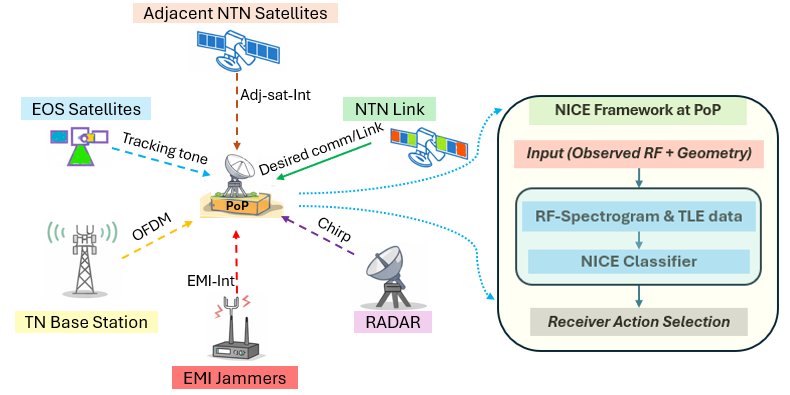
The non-terrestrial network (NTN) system that we consider is in the featured image above. The central Point of Presence (PoP) receives a desired NTN link alongside multiple interference sources. The NICE framework that we propose at the PoP classifies the interference and link quality and select optimal receiver actions.
Future wireless systems will increasingly combine terrestrial and non-terrestrial infrastructure, including low-earth orbit satellites, relays, and edge intelligence. In these systems, the wireless environment changes rapidly because satellites move, links appear and disappear, and interference can originate from many different sources such as terrestrial OFDM systems, radars, jammers, or nearby satellites. This creates a major challenge: the received signal may look abnormal, but it is often hard to tell why it looks that way using RF observations alone.
A practical way to make these systems smarter is to combine the observed signal with physical context. In our work, that context comes from TLE-derived orbital information such as relative geometry, elevation, range, and Doppler-related motion. Together with RF spectrograms, these inputs enable a multimodal learning system to identify interference type and link quality more reliably than RF-only processing. In parallel, reinforcement learning can use measured link conditions to adapt spectral overlap in dual-satellite NTN backhaul, improving throughput while respecting link constraints.
Technical contributions
This project looked at two problems:
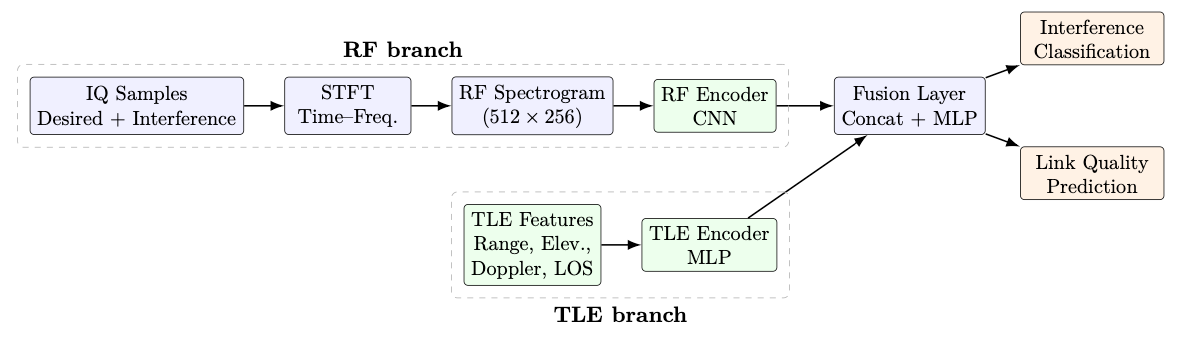
A multimodal AI framework that fuses RF spectrograms with TLE-derived orbital features. The RF branch converts complex baseband signal captures into time–frequency spectrograms, while the TLE branch encodes geometry-aware features such as slant range, elevation, and motion. A dual-encoder architecture then combines both representations and predicts two outcomes: the interference mode affecting the link and the resulting link-quality class. This is useful because the RF signal tells us what was observed, while the orbital context helps determine what is physically plausible.
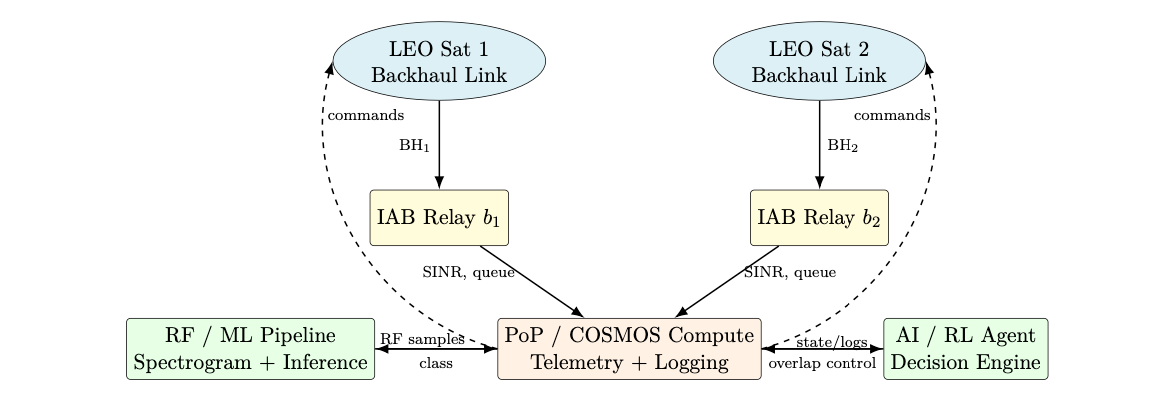
An adaptive backhaul control for dual-satellite NTN IAB (Fig.3) operation. Here, a lightweight Q-learning controller uses measured SINR, queue occupancy, and geometry-aware state information to adjust spectral overlap between two satellite backhaul links. Instead of using a fixed overlap policy, the controller learns how to trade off multiplexing gain against harmful interference and degraded quality of service. Together, these two directions show how AI can be used both for sensing and for control in future NTN systems.
Using COSMOS for validation
COSMOS is valuable because it supports experiments that span multiple layers of the system. RF signals and interference patterns can be generated or replayed through SDR-based pipelines, network dynamics can be emulated or integrated with simulation, and machine learning models can run on local or remote compute resources. This makes it possible to validate not just a classifier or controller in isolation, but a complete measure–infer–act loop.
For multimodal sensing, COSMOS can be used to collect or replay RF samples, synchronize them with satellite or geometry metadata, and evaluate whether AI models remain accurate under realistic impairments. For NTN IAB control, COSMOS-style experiments can validate whether observed SINR, queue state, and control latency are sufficient for closed-loop spectral adaptation. More broadly, COSMOS enables cross-layer experimentation where RF sensing, network performance, and AI decisions are all visible in one workflow.
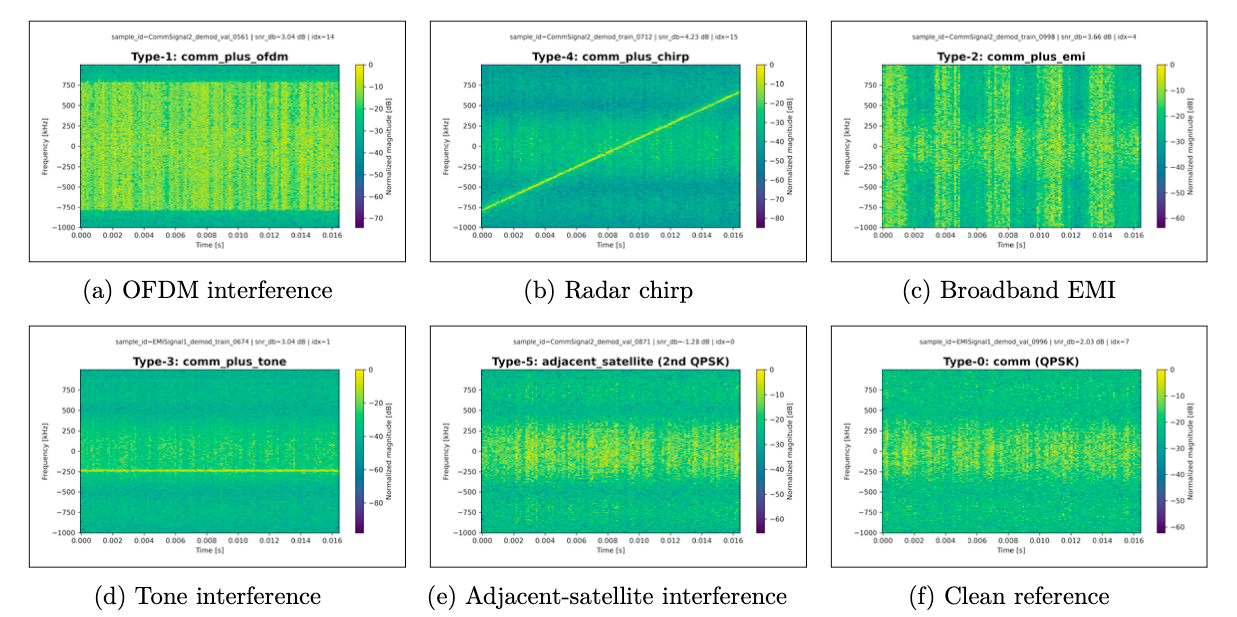
The multimodal sensing results show that combining RF and TLE information improves classification reliability over RF-only baselines, especially in cases where two signal types look similar in the spectrogram but differ in physical plausibility. This is particularly helpful in distinguishing adjacent- satellite interference, chirp-like interference, tone-like interference, and ambiguous link-quality regimes. The result is a more robust geometry-aware interference perception pipeline.
The control results show that adaptive policies can outperform fixed spectral-overlap configurations in many operating conditions. Because the controller observes both link quality and traffic state, it can dynamically increase or decrease overlap rather than applying a one-size-fits-all setting. The experiments also indicate that control latency is small relative to the decision timescale, which supports real-world feasibility of such adaptive policies.
Next steps
A natural next step is to replace purely supervised multimodal fusion with contrastive or self- supervised pretraining, so that RF and orbital context are aligned in a shared representation space before the final classifier is trained. This should improve robustness to missing labels, noisy measurements, and unseen operating conditions. Another direction is tighter integration between sensing and control, where interference classification can directly inform spectrum management, scheduling, and handover logic.
Beyond algorithmic extensions, future work should move toward more realistic datasets and hardware-in-the-loop validation. That includes using real RF captures, SDR-based replay of interference patterns, and edge deployment of inference pipelines. These extensions would make the results more representative of practical NTN operation and improve confidence in field deployment.
Suggested enhancements for COSMOS
Expanding GPU availability would accelerate multimodal training and hyperparameter optimization, while edge-based hardware acceleration would enable low-latency inference. Furthermore, tighter integration between SDR toolchains, telemetry, and AI pipelines will help reduce experimental turnaround time.